


Ultra Sun Solar Water Heater
Filter by price
Filter by Brand
Filter by category
Showing the single result
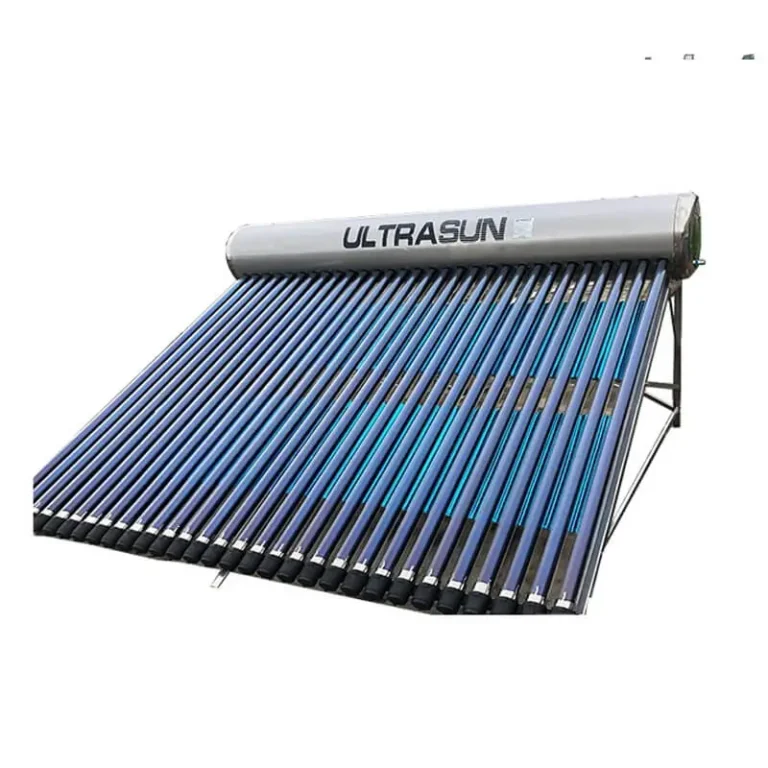
UltraSun 30 Tube Solar Water Heater
Ultra Sun solar water heaters stand apart from most brands available in Nepal through one
measurable technical difference: XL copper oxide evacuated tubes
(58×1800×1.8 mm) with a three-layer AL+SS+CU absorber
coating delivering 96% solar absorbance and 97% transmittance.
That is not marketing language — it is the specification that determines how much hot water
your system produces on a cloudy Kathmandu winter morning or during Nepal’s June
monsoon. At Sewas Mart, we carry four Ultra Sun models — 15, 20, 25, and 30 tube
variants — covering residential households through small commercial installations.
The Ultra Sun 30 Tube is available at Rs. 113,050;
pricing on remaining models is available on inquiry at
01‑4377714.
What Makes Ultra Sun Solar Water Heaters Different in Nepal’s Market?
Most solar water heaters sold in Nepal use standard evacuated glass tubes. Ultra Sun uses
XL copper oxide coated evacuated tubes — larger in diameter
(58 mm vs the 47 mm found in basic models) and thicker in wall construction
(1.8 mm). This matters in Nepal’s climate for a specific reason: larger tubes
have a greater exposed surface area per unit, which means more diffuse solar radiation is
captured on overcast days — precisely the condition Nepal experiences during monsoon
(June–September) and during the foggy winter mornings common in the Kathmandu Valley
and Terai from December through February.
The three-layer absorber coating — Aluminium + Stainless Steel + Copper (AL+SS+CU)
— is the other critical differentiator. Standard single-layer coatings absorb approximately
85–90% of incident solar radiation. Ultra Sun’s three-layer system
achieves 96% absorbance while its selective coating maintains
97% transmittance, meaning the glass lets in nearly all available
light while the copper oxide absorber layer converts nearly all of it to heat. In Nepal’s
terms: your system keeps heating water when your neighbours’ cheaper units have
already stopped.
Below is a direct comparison of the technical specifications that separate Ultra Sun
from standard evacuated tube solar water heaters widely available in Nepal.
| Feature | Ultra Sun | Standard Nepal Market Models | Why It Matters |
|---|---|---|---|
| Tube diameter | 58 mm XL | 47–58 mm | Larger surface area absorbs more diffuse light on cloudy days |
| Tube wall thickness | 1.8 mm | 1.4–1.6 mm typical | Greater resistance to hail and mechanical stress |
| Absorber coating | 3-layer AL+SS+CU | Single-layer copper oxide | 96% absorbance vs 85–90% for standard coatings |
| Inner tank material | SUS-304 extra-thick | SUS-304 standard grade | X-TRA thick grade resists corrosion from Nepal’s varying water mineral content |
| Outer tank material | SUS-304 stainless steel | Powder-coated steel (most brands) | SUS-304 outer tank will not rust on rooftops exposed to monsoon rain |
| Tank corrosion protection | Magnesium anode system | Not included in most Nepal market brands | Sacrificial magnesium anode prevents internal scaling and corrosion from hard water |
| Insulation | 50mm PUF at 45 kg/m³ | 50–60mm PUF standard density | High-density PUF reduces heat loss overnight — water stays warm longer |
| Tank welding | CNC + laser welding | Standard argon arc welding | Laser and CNC welding produces tighter, more consistent seals at inlet/outlet points |
| Maintenance access | Built-in flush cleaning point | No internal flush point | Allows periodic mineral deposit flushing without full disassembly |
| Support structure | SUS-202 stainless steel, 30° angle | Powder-coated mild steel | Stainless steel frame will not rust on exposed Kathmandu rooftops |
The Magnesium Anode: Why It Matters Specifically for Nepal’s Water Quality
Nepal’s municipal water supply — particularly in Kathmandu Valley, the Terai, and
cities served by borewell sources — carries varying levels of calcium, magnesium, and iron
minerals. Over time, these minerals form scale deposits on the inner walls of a solar water
heater tank. Unchecked scaling reduces effective tank capacity, degrades heat retention, and
eventually corrodes the inner tank surface — shortening the unit’s service life from
the expected 15–20 years down to 8–10 years.
Ultra Sun includes a magnesium anode protection system inside the storage
tank — a feature absent from most other solar water heater brands sold in Nepal at this price
point. The magnesium anode works on a simple electrochemical principle: the magnesium metal
is more reactive than the stainless steel tank, so it corrodes first, acting as a sacrificial
layer that protects the tank walls from mineral attack. The anode is consumed slowly over time
and is periodically replaceable — far cheaper than replacing the entire tank.
In practical terms for a Kathmandu household using municipal supply water: the magnesium anode
meaningfully extends the inner tank’s useful life, reduces the frequency of professional
descaling maintenance, and protects the tank during the months when the electric backup heating
element operates — heat accelerates scaling, making the anode’s role particularly
important in winter.
Ultra Sun Solar Water Heater Price in Nepal — All Models (2025)
Ultra Sun offers four tube configurations at Sewas Mart, covering household capacities from
approximately 180 litres through 375 litres. The 30 Tube model is listed at a fixed price;
pricing on the 15, 20, and 25 Tube models is confirmed on inquiry due to stock and variant
availability. Contact us at 01‑4377714
or 9801078049 for a current quote on any model.
| Model | Tubes | Approx. Capacity | Collector Area | Backup Heater | Price (NPR) | Best For |
|---|---|---|---|---|---|---|
| Ultra Sun 15 Tube | 15 XL Tubes | ~ 180 Litres | ~ 1.62 m² | 1500W | Contact for price | 2–3 person household, 1 bathroom |
| Ultra Sun 20 Tube | 20 XL Tubes | 240 Litres (±10%) | 2.16 m² | 1500W | Contact for price | 3–5 person household, 1–2 bathrooms |
| Ultra Sun 25 Tube | 25 XL Tubes | 300 Litres (±10%) | ~ 2.70 m² | 1500W | Contact for price | 5–7 person household, 2 bathrooms, small guesthouse |
| Ultra Sun 30 Tube | 30 XL Tubes | ~ 375 Litres | ~ 3.24 m² | 1500W | Rs. 113,050 (was Rs. 119,000) | Large family, guesthouse, small hotel |
All Ultra Sun models include free delivery and professional installation
within Kathmandu Valley (Kathmandu, Bhaktapur, Lalitpur). All models ship with the
magnesium anode system pre-installed, SUS-202 stainless steel mounting frame, and a
1500W electric backup heating element with thermostat. For delivery to Pokhara, Birgunj,
Chitwan, Butwal, or other cities outside the valley, contact our team for a delivery quote.
Which Ultra Sun Model Is Right for Your Household?
The correct model depends primarily on three variables: how many people live in your home,
how many bathrooms are in active daily use, and whether hot water usage is concentrated
in one time window or spread across morning, afternoon, and evening.
| Household Size | Bathrooms | Usage Pattern | Recommended Model |
|---|---|---|---|
| 2–3 people | 1 | Morning peak | 15 Tube (~180L) |
| 3–5 people | 1 | Morning peak | 20 Tube (240L) — most popular residential size |
| 4–5 people | 1 | Spread across day | 20 Tube (240L) with adequate reserve for evening |
| 5–7 people | 2 | Morning and evening | 25 Tube (300L) |
| 6–8 people / joint family | 2 | Multiple peaks | 25 Tube (300L) or 30 Tube (375L) |
| Small guesthouse / office | 3+ | Commercial staggered | 30 Tube (375L) |
For hilly regions specifically: If your home is in Pokhara, Dharan,
Dhulikhel, or Tansen — where winter temperatures are significantly lower than Kathmandu
Valley and monsoon cloud cover is heavier — size up one model from the table above.
A family of 4 that would normally need the 20 Tube in Kathmandu will benefit from the
25 Tube in Pokhara, where fewer peak sunshine hours mean the system stores less energy
per day during winter months. Ultra Sun’s 3-layer absorber technology mitigates
this more than standard tube systems — but the extra storage reserve of a larger tank
remains the most practical insurance against cold-season shortfall.
If you are still deciding on the right capacity independently of brand, our
200 litre solar water heater,
300 litre solar water heater, and
350 litre solar water heater
category pages cover all brands available at each capacity, with household sizing guides and
current Nepal prices — useful if you want to compare Ultra Sun against Neo, Appolo, DHI,
Osmo, and Volta Sun at the same litre size before deciding.
Ultra Sun vs Other Solar Water Heater Brands in Nepal: Who Should Choose Ultra Sun?
Ultra Sun is not the cheapest brand available at Sewas Mart, and it should not be. A solar
water heater is a 15–20 year purchase. The difference in total lifetime cost between
a Rs. 34,500 entry-level unit and a premium model often disappears entirely when you
factor in electricity savings, maintenance frequency, and tank replacement risk. Here is an
honest breakdown of when Ultra Sun is the right choice and when another brand will serve
you just as well.
Choose Ultra Sun if:
-
Your water source has high mineral content. Borewell-supplied homes
in Kathmandu’s outskirts and most Terai cities have water with elevated calcium
and iron levels. The magnesium anode protection system in Ultra Sun tanks directly
addresses this — no other brand at this price point in the Nepal market includes it. -
You want both inner and outer stainless steel tanks. Most brands use
SUS-304 stainless steel for the inner tank but powder-coated steel for the outer shell.
Ultra Sun uses SUS-304 on both. On a rooftop exposed to Nepal’s monsoon rain for
20 years, this difference is visible. -
You are in a hilly or cold region where overcast performance matters.
The 3-layer AL+SS+CU absorber at 96% absorbance is specifically designed
for low-light conditions. For Pokhara, Dharan, and high-altitude installations, this
outperforms single-layer coated tubes on diffuse radiation days. -
You value long-term structural integrity on the rooftop. The SUS-202
stainless steel mounting frame will not corrode after 3–4 monsoon seasons the way
powder-coated mild steel frames do. The laser and CNC welded tank seals are tighter and
more uniform than standard welding. -
You are installing for a guesthouse, hotel, or commercial property.
The 25 Tube and 30 Tube models with 300–375 litre capacity and commercial-grade
construction are well-suited for hospitality applications where downtime for repairs
is costly.
Consider other brands if:
-
Budget is the primary constraint for a small household. The
Neo Sun Plus 15 Tube
at Rs. 40,990 and the
DHI 15 Tube
at Rs. 36,000 are both solid, well-supported choices for a 2–4 person household
in Kathmandu Valley where water quality is manageable. -
You need a 5-year warranty and strong local service network. Neo’s
5-year warranty and wide Nepal distribution network make it the benchmark for after-sales
support in this category. Ultra Sun’s nationwide service network is growing — confirm
service availability in your specific city before purchasing. -
You need a copper panel system for high-pressure plumbing.
All Ultra Sun models are evacuated tube systems designed for gravity-fed, non-pressurized
water supply — the standard setup in most Nepali homes. If your building uses a pressure
booster pump, the
copper panel solar water heater
category is more appropriate.
Ultra Sun Technical Specifications Explained for Nepal Buyers
How the XL Evacuated Tube System Works
Each Ultra Sun evacuated tube consists of two coaxial borosilicate glass tubes with a
vacuum sealed between them. The vacuum eliminates convective heat loss — the same principle
used in a thermos flask. The inner tube carries the copper oxide three-layer absorber
coating that converts sunlight to heat. Water or a heat-transfer fluid inside the inner
tube absorbs this heat and rises by the thermosiphon principle — natural
convection caused by the density difference between hot and cold water — into the insulated
storage tank above. No pump or electrical input is required for this process.
Ultra Sun’s tubes are rated at 58 mm outer diameter and 1800 mm length —
making them XL compared to the 47 mm tubes used in entry-level models. The
larger diameter means each tube has approximately 50% more exposed absorber surface
area compared to a 47 mm tube of the same length. This directly translates to more
heat collected per tube per day, particularly on partially cloudy days where diffuse
radiation is the primary source.
The 50mm High-Density PUF Insulation Layer
The storage tank is surrounded by 50 mm thick polyurethane foam (PUF)
insulation at 45 kg/m³ density. Higher density PUF has lower thermal
conductivity — meaning heat escapes from the stored water more slowly. For a Nepal household,
this translates to water heated on a sunny afternoon remaining hot enough for morning showers
the following day, even in winter without the backup electric element activating. The 45 kg/m³
specification is at the upper end of what is used in solar water heaters in the Nepal market.
The 1500W Electric Backup Heating Element
All Ultra Sun models include a 1500-watt electric backup heating element
with an automatic thermostat. This element activates only when water temperature falls below
the thermostat’s set threshold — during extended monsoon cloudy periods or Nepal’s
coldest January nights. At NEA’s domestic tariff of Rs. 9.90 per unit for
20–150 unit consumption households, the 1500W element costs approximately
Rs. 15 per hour of operation. Because Ultra Sun’s high-absorbance tubes and
dense insulation minimise the days when backup heating is needed, this element operates
far less frequently than it would in a lower-specification system — which is precisely
where the long-term electricity saving comes from.
CNC and Laser Welding at Inlet and Outlet Points
Tank failure in solar water heaters most commonly originates at the welded connection
points — where the inlet, outlet, air vents, and backup heater housing join the tank body.
Ultra Sun uses CNC-machined components and laser welding at these critical
points rather than standard manual argon arc welding. CNC machining produces uniform
fitting geometries; laser welding produces narrow, deep, consistent fusion zones without
heat distortion of the surrounding tank material. The result is connection points that are
more resistant to thermal expansion cycling — the repeated heating and cooling that tank
fittings experience over 15–20 years of daily operation in Nepal’s climate.
The Internal Flush Cleaning Point
Ultra Sun includes an additional flush point inside the tank — a design
feature that allows a technician to connect a water line and flush mineral sediment from
the tank bottom without removing the tank from the mounting frame. In Nepal’s hard
water areas, particularly Kathmandu Valley and the Terai, annual flushing of sediment
that settles from municipal supply water significantly extends tank life. On systems without
a dedicated flush point, this maintenance requires full disassembly — increasing service
cost and discouraging the maintenance that protects long-term system performance.
Ultra Sun Performance Across Nepal’s Different Regions and Climates
Kathmandu Valley
In Kathmandu, Bhaktapur, and Lalitpur, Ultra Sun’s 20 Tube (240L) is the recommended
residential model for households of 3–5 people. The valley’s winter fog from
December through February reduces direct solar radiation — Ultra Sun’s 96%
absorbance rating means the system continues effective heating on foggy mornings where
standard single-coating tubes drop significantly in output. The SUS-304 outer tank and
SUS-202 stainless steel frame are well suited to Kathmandu’s monsoon exposure and
the elevated particulate pollution that accelerates corrosion of powder-coated steel frames
on competing models.
Pokhara and Hilly Regions
Pokhara receives Nepal’s heaviest rainfall and some of its most persistent monsoon
cloud cover — making it one of the most challenging environments for solar water heaters
in the country. Ultra Sun’s three-layer absorber technology is specifically valuable
here: diffuse radiation from cloudy skies is still captured at meaningful efficiency, unlike
flat-plate copper panel systems and some lower-specification evacuated tube models that
require direct sunlight for effective performance. For Pokhara households, we recommend
the 25 Tube (300L) over the 20 Tube as a standard sizing buffer for cloudy-day reserve.
The 30-degree-angled SUS-202 frame is also relevant: Pokhara’s wind conditions make
structural stability more important than in sheltered valley installations.
Terai Region (Birgunj, Butwal, Chitwan, Dhangadhi)
Nepal’s Terai receives the most consistent year-round direct sunlight of any region
in the country. In Terai cities, Ultra Sun’s high-absorbance specification operates
comfortably above its rated output for much of the year — the 20 Tube will reliably heat
its full 240 litres by mid-morning on a clear Terai winter day. The more critical advantage
of Ultra Sun in the Terai is the magnesium anode protection system: many
Terai municipalities and borewell sources have significantly higher mineral content than
Kathmandu Valley supply, making the anti-scaling protection more valuable here than anywhere
else in Nepal. For Terai households with hard borewell water, the Ultra Sun tank’s
protection technology can meaningfully extend the tank’s effective service life
compared to unprotected stainless steel tanks.
Monsoon Season Performance (June–September)
During Nepal’s monsoon, all evacuated tube solar water heaters continue producing
hot water on overcast days — a key advantage over flat-plate copper panel systems. Ultra
Sun’s 96% absorbance coating maximises this advantage: on a typical monsoon
overcast day, expect 55–70% of normal hot water output, depending on cloud
density and duration. The 1500W backup heating element with thermostat ensures continuous
hot water supply during extended monsoon rainy periods when solar yield drops below
household demand — without manual intervention.
How Much Will an Ultra Sun Solar Water Heater Save on Your NEA Bill?
A 240-litre Ultra Sun 20 Tube system replaces a standard 2–3 KW electric geyser
that a 4–5 person Nepal household would otherwise run 2.5–3 hours per day through
the winter months. At NEA’s domestic tariff of Rs. 9.90 per unit
for households in the 20–150 unit monthly consumption bracket, a 2 KW electric
geyser costs approximately Rs. 50–60 per day in heavy-use months.
The Ultra Sun system eliminates the majority of this cost for 8–9 months of the year,
with the 1500W backup element partially contributing during the 3–4 winter and monsoon
months when solar yield is reduced. A typical 4–5 person Kathmandu household switching
from an electric geyser to an Ultra Sun 20 Tube saves approximately
Rs. 8,000–12,000 per year in electricity costs, depending on
usage pattern and seasonal cloud cover.
At the Ultra Sun 20 Tube’s price point (available on inquiry), this places the
payback period at approximately 7–10 years — after which the
remaining 10+ years of the system’s 20-year service life produce hot water
with no fuel cost whatsoever. The SUS-304 dual-tank construction and magnesium anode
protection are specifically what support achieving that 20-year service life in Nepal’s
water conditions.
Ultra Sun Installation and After-Sales Service at Sewas Mart
Free Installation in Kathmandu Valley
All Ultra Sun purchases through Sewas Mart include free delivery and professional
installation within Kathmandu, Bhaktapur, and Lalitpur. Our installation team
carries out a rooftop assessment before mounting — confirming structural load capacity for
the Ultra Sun system’s full weight (approximately 280–380 kg fully filled
depending on model), identifying the optimal south-facing orientation for maximum annual
solar yield, and verifying pipe routing from rooftop to the bathroom connection point.
Recommended Rooftop Orientation
For Nepal’s latitude (approximately 28°N), the optimal collector orientation is
due south at a 25–30° inclination from horizontal. The Ultra Sun
mounting frame is pre-engineered at a 30° angle — closely matching this ideal. Any
deviation from south-facing orientation reduces annual energy yield: west-facing installations
(common on some Kathmandu rooftops due to space constraints) typically yield 15–20%
less annual output than south-facing installations. Our installation team will advise on
the best available orientation on your specific rooftop.
Annual Maintenance
Ultra Sun’s built-in flush cleaning point makes annual maintenance more straightforward
than most competing systems. Standard annual maintenance includes cleaning the outer glass
surface of the evacuated tubes (to remove dust and Kathmandu Valley air pollution deposits),
flushing mineral sediment via the internal flush point, inspecting the backup heating
element thermostat, and checking the magnesium anode for depletion. Sewas Mart provides
after-sales service and maintenance for all Ultra Sun systems we supply.
Single Tube Replacement
If a tube cracks due to hail impact or physical damage — a concern particularly in
Pokhara and hilly areas with occasional hailstorms — Ultra Sun’s 1.8 mm tube
wall thickness provides better resistance than standard 1.4–1.6 mm tubes.
Should a tube require replacement regardless, the evacuated tube design allows individual
tubes to be replaced without disassembling the tank or draining the system — a significant
service advantage over copper panel collectors, where panel damage can require full
collector replacement. Individual replacement tubes cost Rs. 800–1,500 per tube
through Sewas Mart’s after-sales service.
Frequently Asked Questions — Ultra Sun Solar Water Heater in Nepal
What is the price of an Ultra Sun solar water heater in Nepal?
The Ultra Sun 30 Tube solar water heater is priced at Rs. 113,050
at Sewas Mart (reduced from Rs. 119,000). Pricing for the 15, 20, and 25 Tube models
is available on inquiry — contact us at
01‑4377714 or
9801078049 for a current quote. All
Ultra Sun prices include free delivery and installation within Kathmandu Valley.
What is the capacity of the Ultra Sun 20 Tube solar water heater?
The Ultra Sun 20 Tube is rated at 240 litres per day (±10%)
— adequate for a household of 3–5 people sharing one bathroom in Nepal’s
typical residential usage pattern. Actual daily output will vary based on solar irradiance,
ambient temperature, and usage timing.
How does Ultra Sun perform during Nepal’s monsoon season?
Ultra Sun’s three-layer AL+SS+CU absorber with 96% absorbance continues
to heat water from diffuse radiation on overcast days — the typical condition during Nepal’s
June–September monsoon. On fully cloudy days, expect approximately 55–70% of
normal output. The integrated 1500W backup electric heating element with thermostat
automatically compensates during extended low-sunlight periods.
Does Ultra Sun work during NEA load shedding?
The solar heating function operates entirely without electricity — no grid power is required
for normal thermosiphon operation. During load shedding, the system continues heating water
normally through solar collection. Only the 1500W backup electric element requires grid power;
it cannot activate during load shedding but resumes automatically when power is restored.
Is the magnesium anode system in Ultra Sun relevant for my location in Nepal?
If your home uses borewell water — common in Kathmandu’s outer areas, Lalitpur, and
most Terai cities — the magnesium anode protection system is directly relevant. Borewell
water typically carries elevated calcium, magnesium, and iron levels that accelerate internal
tank scaling. The magnesium anode sacrificially protects the SUS-304 inner tank walls from
this mineral attack. For homes on well-maintained municipal supply (central Kathmandu),
the benefit is present but less critical.
How long does an Ultra Sun solar water heater last?
Ultra Sun systems are built to a 15–20 year service life with proper annual maintenance.
The SUS-304 dual-tank construction, magnesium anode protection, high-density PUF insulation,
and laser-welded connection points collectively contribute to this longevity — each addressing
a specific failure mechanism common in Nepal’s climate and water conditions.
How does Ultra Sun compare to Neo solar water heaters?
Neo solar water heaters are among the most widely distributed brands in Nepal and offer
strong value in the mid-range segment, particularly with their 5-year warranty coverage —
a meaningful advantage for buyers prioritising warranty support. Ultra Sun differentiates
through superior tube specification (3-layer absorber, XL diameter), dual SUS-304 tank
construction, and the magnesium anode protection system — features that justify the
premium for buyers with hard water sources, hilly-region installations, or commercial use.
Both are authorised through Sewas Mart with full after-sales support.
Comparing Ultra Sun Against All Brands Before Deciding?
Ultra Sun is one of seven solar water heater brands available at Sewas Mart — alongside
Neo, Osmo, DHI, Appolo, Volta Sun, and Supreme. If you want to compare Ultra Sun’s
specifications and pricing directly against all other brands and capacities in one place,
our complete solar water heater price guide for Nepal
covers every model we carry — with current prices, capacity-to-household sizing tables,
and a full type comparison between evacuated tube and copper panel systems. It is the most
comprehensive solar water heater price reference currently available for Nepal’s market,
and the fastest way to confirm your buying decision before contacting us.